
With the Data Protection Act (DPDPA) on the horizon, organizations are gearing up to implement granular consent mechanisms for the collection, processing, and use of personal data. While the mandate for obtaining informed and specific consent seems straightforward at first glance, organizations are discovering a far more intricate challenge: the internal consent battle across departments.
Understanding Granular Consent
DPDPA emphasizes that data fiduciaries must obtain clear, specific, and granular consent from data principals for every purpose for which personal data is collected. Unlike blanket consent forms of the past, organizations now must explicitly communicate:
- What data elements (PII) are being collected
- For which purposes each piece of data will be used
- Who within the organization or outside will access the data
This regulatory requirement is designed to empower users, giving them control over their data. However, in practice, implementing granular consent across a large organization can become a complex operational puzzle.
The Internal Consent Battle
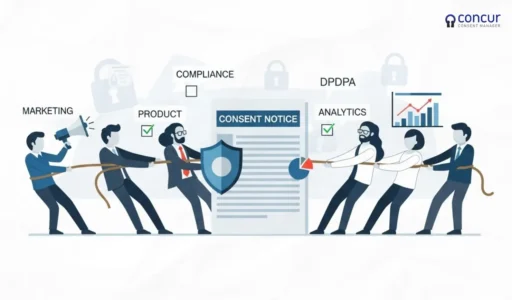
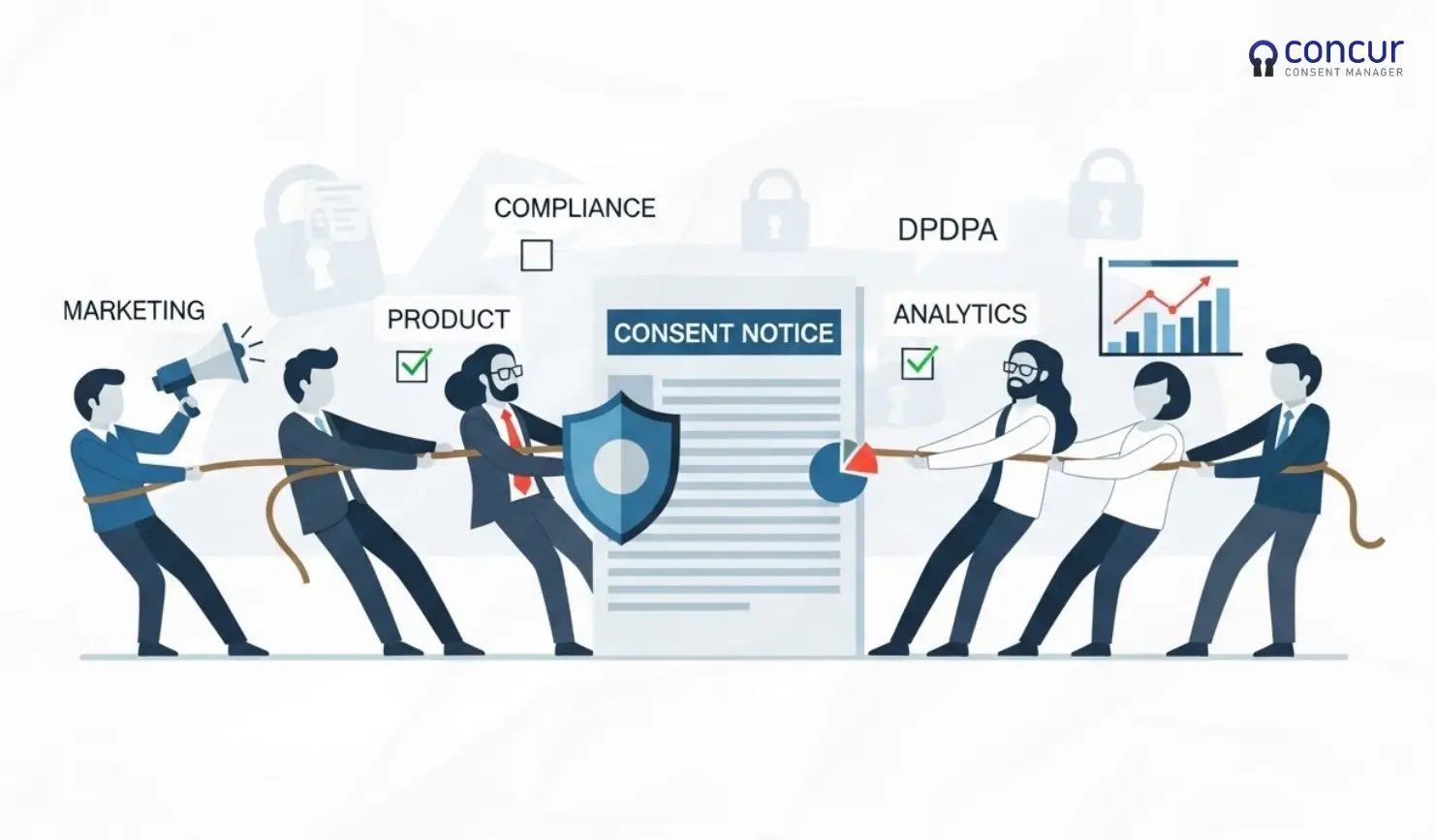
Organizations typically collect PII data once but multiple departments want to use it—marketing, sales, HR, risk, analytics, product development, and more. Each department may have its own purpose for the data, some strategic, some operational.
Here’s where the “consent battle” begins:
- Limited Space in Consent Notices – Consent notices have a practical limit. While technically an organization can list as many purposes as desired, research and experience show that long, complex notices reduce user engagement and acceptance probability. Users are more likely to reject consent if overloaded with purposes, or they may give partial consent, leaving departments without necessary data.
- Departmental Competition – Departments often compete internally to include their purposes in the consent notice. Marketing might want to track user behavior for personalized campaigns; product teams may want analytics data to improve features; HR may want demographic information for internal studies. Each department believes its purpose is critical, but only a subset of purposes can realistically be included to maintain a high probability of user consent.
- High-Stakes Decision Making – Choosing which departmental purposes make it to the consent notice becomes a strategic decision, often involving trade-offs between business priorities and compliance requirements. This is especially challenging in large organizations where multiple stakeholders may have conflicting interests.
Why This is a Big Problem
While it may appear as a minor operational issue, experience from client engagements indicates it is one of the most significant challenges in implementing DPDPA compliance:
- Risk of Non-Compliance: If critical purposes are excluded or consent is poorly communicated, departments may process data without proper legal grounding.
- Operational Bottlenecks: Obtaining internal approvals for consent purposes can slow down product launches and marketing campaigns.
- User Trust Impact: Poorly designed notices or overextended purpose lists can reduce user trust and increase opt-out rates.
Example Scenario: The Consent Battle at FinTechCo
Background: FinTechCo is a mid-sized financial services company that collects personal data (PII) from its users during account creation, including:
- Name, email, phone number
- Date of birth
- Transaction history
- Spending preferences
- Geolocation data
Multiple departments want to use this data for different purposes:
| Department | Purpose |
| Marketing | Personalized promotional campaigns |
| Product | Feature improvement and recommendation algorithms |
| Risk & Compliance | Fraud detection and AML (Anti-Money Laundering) checks |
| Customer Support | Troubleshooting and account verification |
| Analytics | Trend analysis and business reporting |
Step 1: Drafting the Consent Notice
FinTechCo needs to create a consent notice that lists all purposes for which it will use user data. If they list all 5 purposes explicitly, the notice becomes long and users may skim through or reject it entirely, reducing overall acceptance rates.
Step 2: Internal Debate
A departmental battle begins:
- Marketing argues that targeted promotions generate revenue and must be included.
- Risk & Compliance insists fraud detection is critical and legally mandated.
- Analytics says aggregated trend analysis is essential for strategic decisions, but optional if it reduces acceptance rates.
- Product team wants to use the data for AI-driven recommendations but could survive if consent is partial.
Here, the organization realizes that not all purposes can realistically make it to the notice without affecting user consent probability. They must prioritize.
Step 3: Prioritization
FinTechCo uses a purpose prioritization framework:
- Critical for Legal Compliance: Risk & Compliance → included
- Critical for Revenue Impact: Marketing → included
- Important for Product Improvement: Product → considered optional
- Useful for Business Insights: Analytics → deferred
- Operational Support: Customer Support → included, but limited to minimal necessary data
Step 4: Outcome
By managing internal priorities and structuring the consent notice effectively:
- Compliance Risk is minimized for legally critical purposes
- Marketing campaigns retain potential reach through optional opt-ins
- Product and analytics teams can still access data from users who opted in
- User trust is maintained through transparency and control
This scenario demonstrates how the internal consent battle is not just administrative friction—it directly impacts compliance, revenue, user trust, and data accessibility.
Insights and Best Practices
Organizations can tackle the internal consent battle using a structured approach:
- Purpose Prioritization Framework – Establish a framework to rank departmental purposes based on business criticality, regulatory importance, and user value. Not all purposes are equal; some may be optional or non-critical.
- Data Governance Council – Create a cross-functional council with representatives from all departments to review and approve consent purposes. This ensures that decisions are collaborative, transparent, and aligned with compliance strategy.
- Purpose Grouping and Layered Notices – Instead of listing dozens of granular purposes individually, group similar purposes together and provide layered consent options. For example: “We may use your data for product improvement, marketing, or analytics—select the ones you agree to.”
- Analytics-Driven Approach – Run pilot programs to measure user consent rates for different notice formats and purpose lists. This allows organizations to optimize notices for both compliance and user acceptance.
- Automated Consent Management- Implement a Consent Management Platform (CMP) to manage consent preferences dynamically. This enables departments to access the data they are authorized for without violating DPDPA requirements and simplifies auditing.
The “consent battle” within organizations is more than just an internal coordination problem—it is a strategic and operational challenge central to DPDPA compliance. By prioritizing purposes, fostering cross-functional governance, and leveraging technology, organizations can navigate this complex landscape.
Ultimately, winning the internal consent battle ensures that the organization not only stays compliant but also respects user trust, which is critical in today’s privacy-conscious market.