


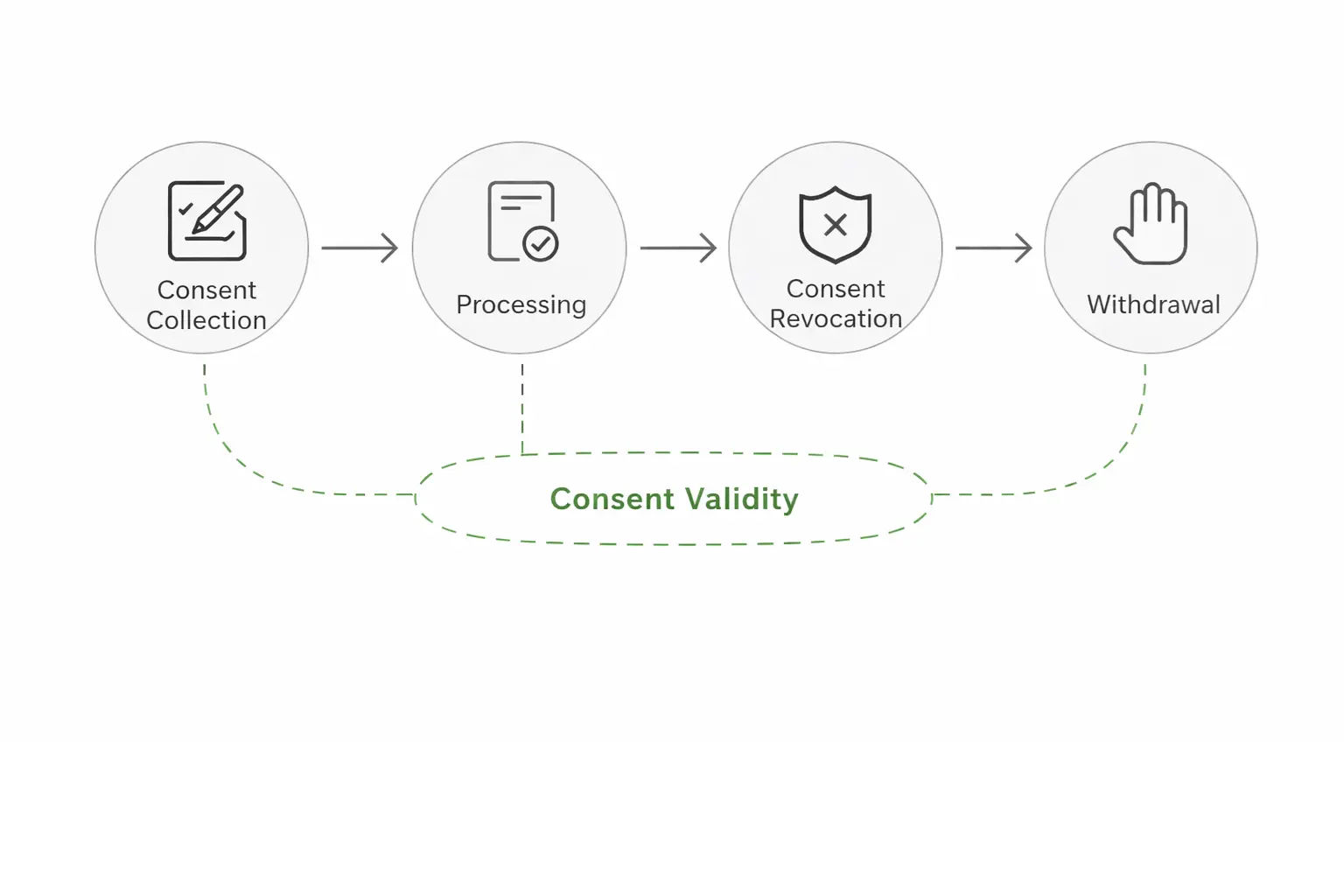
Under India’s Digital Personal Data Protection Act, 2023 (DPDPA), consent is not a one-time checkbox—it is a time-bound, purpose-bound, and lifecycle-driven legal instrument. One of the most overlooked aspects of consent governance is the Consent Validity Date and its relationship with data retention, purpose limitation, and consent renewal.
Organizations that fail to manage consent over time risk continuing data processing after consent has legally expired, exposing themselves to regulatory action, penalties, and reputational damage.
- What Consent Validity Date means
- How it differs from data retention period
- When and how consent must be renewed
- Practical guidelines for managing consent lifecycle under DPDPA
1. What Is Consent Validity Date?
Consent Validity Date refers to the time period for which a user’s consent remains legally effective for a specific purpose of data processing. In simple terms: Consent is valid only as long as it is necessary and relevant for the stated purpose and until it is withdrawn, expired, or superseded. While DPDPA does not mandate a fixed expiry period for all consents, it clearly requires that consent be:
- Specific
- Purpose-limited
- Capable of being withdrawn
- Not perpetual by default
Above that makes time-bound consent governance a compliance necessity, not an optional best practice.
2. Consent Validity Date vs Data Retention Period
A common compliance mistake is assuming that consent validity and data retention are the same thing. They are not.
| Aspect | Consent Validity Date | Data Retention Period |
| Meaning | How long consent authorizes processing | How long data is stored |
| Driven by | Purpose, user expectation, fairness | Legal, regulatory, business requirements |
| Ends when | Consent expires, is withdrawn, or purpose changes | Purpose ends or legal retention expires |
| Risk if mismanaged | Unlawful processing | Excessive data storage |
👉 Key rule: Even if data is lawfully retained (e.g., for legal or audit reasons), processing must stop once consent is no longer valid.
3. How DPDPA Implicitly Enforces Consent Validity
Although DPDPA does not explicitly define a “consent expiry clause,” it enforces consent validity through multiple provisions:
- Section 6 – Consent must be specific and limited to stated purposes
- Section 8(7) – Data must be deleted once purpose is no longer served
- Purpose Limitation Principle – Processing cannot continue beyond necessity
- Right to Withdraw Consent – Processing must stop after withdrawal
Together, these create a legal expectation that consent cannot be indefinite unless the purpose itself is ongoing and justified.
4. When Does Consent Become Invalid?
Consent becomes invalid in any of the following situations:
- Purpose is fulfilled
Example: Consent taken for onboarding is no longer needed after account closure. - Purpose materially changes
Example: Data collected for service delivery is later used for marketing. - Consent validity period expires
Example: Consent granted for a 12-month campaign lapses. - User withdraws consent
Processing must stop immediately for that purpose. - Consent is superseded
Example: User gives new consent with updated terms or purposes.
5. Consent Renewal: When Is Re-Consent Required?
Consent renewal (re-consent) is required when:
Purpose Changes or Expands – If data is proposed to be used for a new or broader purpose, fresh consent is mandatory.
Long-Term or Continuous Processing – For ongoing services (subscriptions, monitoring, profiling), consent should be periodically reaffirmed to remain fair and informed.
Regulatory or Policy Changes – If privacy notices or processing practices materially change, users must be asked to re-consent.
Inactive Users – For dormant accounts, consent validity should be reassessed before reactivation or renewed processing.
6. Best-Practice Consent Renewal Guidelines – While DPDPA does not prescribe fixed renewal intervals, industry-aligned best practices include:
| Use Case | Recommended Review / Renewal |
| Marketing & communications | 6–12 months |
| Analytics & profiling | Annual review |
| Financial / sensitive data | Purpose-based or shorter intervals |
| Long-term customer accounts | Event-based or policy-change based |
7. Managing Consent Validity in Practice
Organizations should implement the following controls:
Consent Metadata Management and each consent record should at least store details like Consent start date, Consent validity or review date, Purpose ID, Notice version, Language of consent
Automated Expiry & Alert and then Systems should data principals when alert when consent is nearing expiry and thereafter automatically block processing when consent lapses
Consent-State Enforcement and prior to pocessing systems must check:
- Is consent still valid?
- Is the purpose still active?
- Has consent been withdrawn or superseded?
Relationship Between Consent Validity and Audit Readiness
During audits or DPBI inquiries, regulators are likely to ask:
- When was consent given?
- Is it still valid for this purpose?
- Why is processing continuing today?
- Was re-consent required but skipped?
Failure to answer these clearly often results in invalid consent determination, unlawful processing findings and potentially penalties and corrective directions
Common Pitfalls to Avoid
❌ Treating consent as “lifetime approval”
❌ Continuing processing after purpose completion
❌ Retaining consent without renewal for years
❌ Confusing legal data retention with consent validity
❌ No system-level enforcement of consent expiry
Under DPDPA, consent is not static—it ages. Organizations that actively manage consent validity dates, renewal triggers, and retention boundaries will not only reduce regulatory risk but also build long-term trust with users. In the era of data protection enforcement, expired consent is as risky as no consent at all.