
Updated June 2026
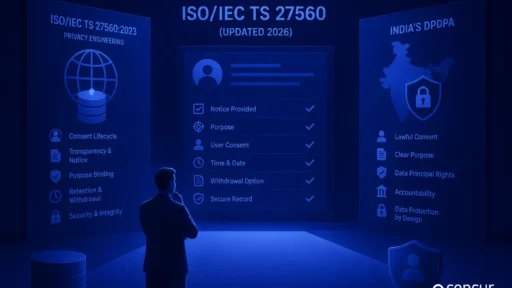
Consent is at the heart of the Digital Personal Data Protection Act (DPDPA), 2023. Organizations cannot simply collect personal data and use it indefinitely. They must obtain valid consent, manage it throughout its lifecycle, and respect the rights of Data Principals (individuals whose personal data is being processed).
Many organizations think consent is a one-time checkbox. In reality, consent is a continuous process that begins before data collection and continues until the consent is withdrawn, expires, or is terminated.
Understanding the lifecycle of consent is essential for compliance, audit readiness, and maintaining customer trust.
What Makes Consent Valid Under DPDPA?
For consent to be legally valid under the DPDPA, it must be:
Informed
The Data Principal must receive clear information about:
- What personal data is being collected
- Why it is being collected
- How it will be used
- Who will process it
- How long it will be retained
This information is typically provided through a Consent Notice.
Freely Given
Consent must be voluntary.
The individual should not be forced, pressured, or misled into providing consent. Where possible, core services should remain available even if optional consent is declined.
Specific and Unambiguous
The Data Principal must take a clear affirmative action indicating agreement. Pre-ticked checkboxes, vague language, or bundled consent mechanisms can create compliance risks.
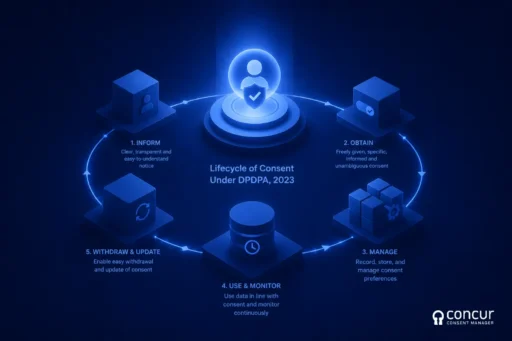
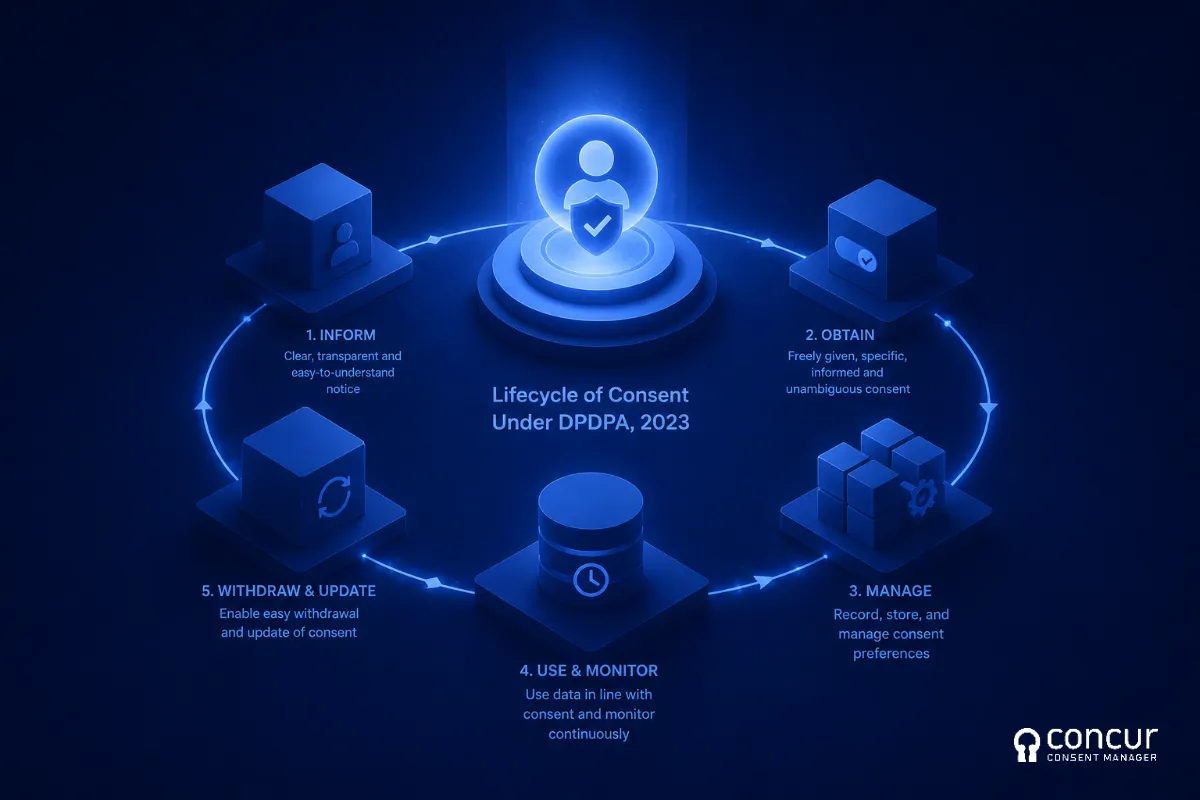
The Consent Lifecycle Under DPDPA
Consent is not a single event. It follows a lifecycle that organizations must manage and document.
| Stage | Description |
|---|---|
| Notice Delivery | Inform the Data Principal about processing activities |
| Consent Collection | Capture explicit consent |
| Consent Validation | Verify consent meets legal requirements |
| Consent Recording | Store proof of consent |
| Consent Usage | Process data according to approved purposes |
| Consent Monitoring | Track validity and changes |
| Re-consent | Obtain fresh consent when required |
| Withdrawal | Stop processing upon withdrawal |
| Audit & Provenance | Maintain records for compliance |
1. Consent Notice
The lifecycle begins with a Consent Notice.
Before collecting personal data, organizations must clearly explain:
- Purpose of processing
- Categories of personal data collected
- Retention period
- Third-party involvement
- Rights of the Data Principal
- Process for withdrawing consent
A poorly drafted notice can invalidate consent entirely.
For example, a fintech application collecting PAN, Aadhaar, email address, and mobile number must explain why each data element is required and how it will be used.
2. Granting or Refusing Consent
After reviewing the notice, the individual decides whether to provide consent.
If Consent is Granted – The organization may process personal data strictly for the purposes described in the notice.
If Consent is Refused – The organization must not process personal data for those purposes.
For example, a user refusing marketing communications should still be able to access the platform’s core services where marketing consent is not necessary.
3. Consent Recording and Provenance
One of the most overlooked aspects of compliance is proving consent.
Organizations should maintain records such as:
- Timestamp of consent
- Version of notice shown
- Purpose consented to
- Channel used (website, mobile app, offline form)
- Device or transaction identifier
This is often referred to as Consent Provenance.
Without provenance records, organizations may struggle to demonstrate compliance during audits, investigations, or disputes.
4. Re-confirming or Re-consenting
Consent may need to be obtained again when:
- The processing purpose changes
- New categories of personal data are collected
- Regulatory requirements evolve
- Long periods have passed since the original consent
For example, a retail company initially collects data for order fulfilment but later wishes to use the same data for personalized advertising.
Fresh consent should be obtained before introducing the new purpose.
5. Withdrawal of Consent
DPDPA gives Data Principals the right to withdraw consent at any time.
The withdrawal process should be as simple as the process used to provide consent.
Once consent is withdrawn, organizations should:
- Stop processing personal data for that purpose
- Update internal systems
- Notify relevant processors and vendors
- Maintain audit records of withdrawal
For example, if a customer withdraws consent for marketing communications, promotional emails and SMS campaigns should stop immediately.
6. Expiry of Consent
Consent does not necessarily remain valid forever.
Organizations should define:
- Validity periods
- Retention requirements
- Renewal processes
When consent expires, data processing should stop unless fresh consent or another lawful basis applies.
7. Termination of Consent
Consent may also become invalid due to:
- Regulatory intervention
- Court orders
- Invalid collection practices
- Inadequate notices
- Failure to meet DPDPA requirements
Organizations must stop processing data when consent is no longer legally valid.
Common Consent Management Mistakes
Many organizations unintentionally create compliance risks through poor consent practices.
Common mistakes include:
- Bundling multiple purposes into a single consent request
- Using unclear or confusing notices
- Failing to provide withdrawal mechanisms
- Not maintaining consent records
- Sharing data with processors without proper governance
- Continuing processing after consent withdrawal
Consent Collection vs Consent Lifecycle
Many businesses confuse consent collection with consent management.
| Consent Collection | Consent Lifecycle Management |
|---|---|
| Single event | Continuous process |
| Focuses on obtaining consent | Focuses on governing consent |
| Checkbox or form submission | Ongoing monitoring and control |
| Captures agreement | Manages validity, withdrawal and auditability |
Organizations that focus only on collecting consent often struggle during audits because they cannot prove how consent was managed afterwards.
Why the Consent Lifecycle Matters
Effective consent lifecycle management helps organizations:
- Comply with DPDPA requirements
- Improve transparency
- Build customer trust
- Reduce regulatory risk
- Demonstrate accountability
- Maintain audit readiness
As organizations collect increasing volumes of personal data, managing consent throughout its lifecycle becomes just as important as obtaining it in the first place.
A Consent Management Platform (CMP) can help automate notice delivery, consent collection, consent provenance, withdrawal management, preference centres, audit reporting, and Data Principal Rights workflows, enabling organizations to operationalize DPDPA compliance at scale.
Ready to ensure your organization is fully compliant with the Digital Personal Data Protection Act (DPDPA), 2023? Get in touch with Concur – Consent Manager today! Our comprehensive solution simplifies consent management, helping you meet all regulatory requirements effortlessly. Whether you’re looking to streamline your consent processes or enhance data privacy operations, we’re here to guide you every step of the way. Contact us now and start your journey towards seamless DPDPA compliance.