


Last Update: November 2026
India’s Consent Manager ecosystem has entered a new phase following the commencement of the registration framework under the Digital Personal Data Protection Act, 2023.
On 13 November 2026, Section 6(9) of the DPDP Act and Rule 4 of the DPDP Rules, 2025 came into effect. On 14 November 2026, the Ministry of Electronics and Information Technology (MeitY) announced the launch of the online registration portal at dpbi.gov.in, allowing eligible Indian companies to apply for registration as Consent Managers.
The registration framework establishes a formal process for companies seeking to provide Consent Manager services under the DPDP Act. Applicants must meet the prescribed eligibility requirements, including incorporation in India and a minimum net worth of ₹2 crore, along with the applicable technical and operational conditions.
However, there is an important distinction between a company offering consent-management software and a company registered as a Consent Manager under the DPDP Act.
A Consent Management Platform (CMP) can help businesses collect, record and manage user consent for their own processing activities. A statutory Consent Manager is a separate regulated role. It must satisfy the prescribed eligibility conditions and obtain registration from the Data Protection Board of India (DPBI).
Can These Startups Call Themselves Registered Consent Managers?
Not automatically. Having a consent-management product, supporting DPDPA compliance or offering consent-related services does not establish statutory registration.
Under the framework, applicants must be companies incorporated in India and meet the prescribed technical, operational and financial conditions. These include a minimum net worth of ₹2 crore and the other requirements set out in the First Schedule of the DPDP Rules, 2025.
The Board will assess applications against the applicable requirements. Only companies that receive registration can represent themselves as registered Consent Managers under the DPDP Act. The Board is also required to publish the particulars of registered Consent Managers.
Planning to apply for registration? Read our guide to Consent Manager registration in India, covering eligibility requirements, the 17-document readiness checklist and the DPBI application process.
For the official announcement, refer to the MeitY press release on the Consent Manager registration framework.
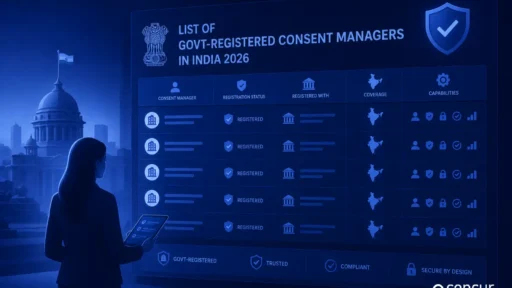
The following comparison covers seven consent-management and privacy solution providers in India. It focuses on their publicly available product information, language support, deployment options, pricing disclosures and notable proof points.
| Company | What It Offers | Languages | Deployment | Pricing | Proof and Status |
|---|---|---|---|---|---|
| Concur Website |
India-focused consent management platform. It brings together consent collection, notice management, preference and withdrawal tracking, and auditable consent records. | 22 Indian languages | Cloud | Not publicly listed | Shortlisted for Code for Consent. LinkedIn lists the company as Mumbai-based, founded in 2023, with 20+ staff. |
| Consentin Website |
Unified platform covering consent, privacy notices, retention and withdrawal, cookies, assessments, third-party risk and breach reporting. | 22 Indian languages | SaaS and on-premise | Monthly packs based on consent collections and checks. | Union Bank of India engaged Leegality to implement it in July 2026. |
| CoTrust by Digio Website |
Consent platform that also covers third-party risk and incident management. It pulls consent purposes from Records of Processing Activities (ROPA). | 22 Indian languages | Not stated | Not published | Digio identifies itself as the official data protection and consent partner of Global Fintech Festival 2026. |
| DPDPA Consultants Website |
Privacy compliance consultancy covering policy, consent management, Data Protection Impact Assessments (DPIAs) and training. | Not found | Not applicable, services-based offering | Clutch lists a minimum project size of US$1,000 or more. | Stanford’s CodeX TechIndex lists the company as inactive. |
| GoTrust Website |
Broader privacy platform covering consent, data discovery, Data Security Posture Management (DSPM), Data Subject Request (DSR) automation, vendor risk and AI governance. | Cookie plan lists English and five regional languages. | SaaS. Cookie tool can be installed using a code snippet. | Cookie tiers include Spark, Velocity and Apex, with overage priced in US dollars per 10,000 actions. Full platform pricing is available by quote. | Reported US$400,000 pre-seed funding led by Aevitas Capital. |
| HyperTrust by HyperVerge Website |
Consent platform with a central dashboard for tracking consent, review and withdrawal activity. | Not found | Not stated | Not found | A February 2025 webinar demonstrated consent tracking, audit logs and APIs. |
| Redacto Website |
India-first, AI-powered platform that treats consent management as part of wider privacy operations. | Not confirmed | SaaS, private cloud and on-premise | Price on request | Shortlisted for Code for Consent. Reports customers across BFSI, healthcare, pharmaceuticals and manufacturing. |
Note: “Not found” or “Not stated” means the information was not located in the public sources reviewed. Product descriptions, language support, deployment options and pricing may change. Shortlisting, funding, customer engagements and event partnerships are not evidence of DPBI registration or regulatory approval.
1. Concur – Consent Manager
Concur is an Indian consent-management platform designed to help businesses manage consent-related processes under the Digital Personal Data Protection Act, 2023. Its offering covers several stages of the consent lifecycle, including consent collection, consent management, tracking and audit documentation.
The platform also offers features such as cookie consent management, incident tracking and data discovery. Its stated capabilities include support for multiple languages, industry-oriented templates and integrations intended for businesses across sectors such as fintech and e-commerce.
Core Features
- Cookie and application consent management
- Consent lifecycle management
- Data breach logging and reporting
- Audit trails and consent records
- API and SDK integrations
- Multilingual consent experiences and industry-specific templates
2. Consentin by Leegality
Consentin by Leegality is an end-to-end consent-management platform designed to support businesses with consent-related processes and DPDPA compliance. Its capabilities include consent notice design, multi-channel consent collection and a centralized dashboard for managing consent records.
The broader offering also includes privacy and compliance tools such as data discovery, data lifecycle management, automated risk assessment and third-party risk management. These capabilities can help organizations coordinate consent workflows and related privacy operations.
Key Features
- Consent notice design and management
- Multi-channel consent collection
- Centralized consent management dashboard
- Workflows for Data Principal rights
- Data reporting and analytics
- Privacy risk assessment and third-party risk management
3. CoTrust by Digio
CoTrust is Digio’s consent-management offering, designed to integrate consent capture into digital identity verification, electronic signature and eKYC workflows. This allows organizations to capture consent as part of user onboarding and other digital transactions.
The platform focuses on maintaining consent records, providing access logs and supporting consent withdrawal. Its integration with Digio’s digital onboarding infrastructure makes it relevant to businesses in regulated sectors such as fintech, telecommunications and insurance, where traceable consent records are important.
Core Features
- Consent management integrated with e-signature workflows
- Integration with identity verification and eKYC processes
- Historical consent records and access logs
- Consent withdrawal support
- Enterprise onboarding integrations
4. DPDPA Consultants
DPDPA Consultants offers a combination of technology tools and specialist support to help organizations manage consent and work towards compliance with India’s data protection framework. Its offering includes tools such as consent notice generators, Data Protection Impact Assessment (DPIA) forms and compliance workflow templates.
The platform is intended to help businesses document data flows, configure consent collection and withdrawal processes, monitor consent status and prepare audit reports. Its combination of software and advisory-oriented support may be relevant to small and medium-sized businesses that need structured privacy processes without maintaining a large in-house technology team.
Core Features
- Customizable consent forms and notices
- DPIA tools and assessment forms
- Data Fiduciary compliance workflows
- Consent collection and withdrawal processes
- Grievance-handling workflows
- Consent monitoring and audit reporting
5. GoTrust
GoTrust is a privacy and consent-management solution designed to help enterprises manage user preferences, notices and permissions through a centralized system. Its offering includes embedded consent forms, cookie banners and configurable purpose-management tools.
The platform focuses on managing consent across channels and maintaining records of user choices. Its stated capabilities include reporting, audit trails and configurable consent experiences for businesses operating in sectors such as e-commerce, BFSI and SaaS.
Core Features
- Cookie and device-level consent management
- Embedded consent forms and user preference portals
- Configurable purpose management
- Consent and data-access records
- Reporting and audit trails
- Support for multiple privacy frameworks, including GDPR and India’s DPDP framework
6. HyperTrust by HyperVerge
HyperTrust is HyperVerge’s consent-management initiative for organizations dealing with complex data permissions and privacy requirements. The offering has been positioned around the use of AI and automation to support consent management across sectors such as healthcare, fintech and edtech.
Its proposed direction includes more granular permission management, industry-oriented compliance configurations and tools to help organizations understand data access and potential privacy risks. As the product develops, its publicly confirmed capabilities and availability should be distinguished from features described as planned or under development.
Proposed Areas of Focus
- AI-assisted consent and privacy workflows
- Granular data permission management
- Industry-oriented compliance configurations
- Data access monitoring and risk identification
- Scalable architecture for enterprise environments
7. Redacto
Redacto offers a consent-management solution designed for organizations that want to manage user permissions across websites and applications. Its platform focuses on helping businesses create consent journeys, record user choices and manage consent modifications and withdrawals.
The offering includes configurable templates, a centralized consent repository and API-based integrations with systems such as customer relationship management (CRM) and customer data platforms (CDPs). Redacto also describes analytics and programmable workflows intended to help privacy teams monitor consent activity and manage permissions at scale.
Core Features
- Configurable consent collection workflows
- Templates for privacy and consent journeys
- Centralized consent repository
- Consent modification and withdrawal management
- Privacy dashboards and analytics
- API and SDK integrations
How to Choose the Right Consent Manager for Your Business
Selecting a Consent Management Platform (CMP) is not simply about finding a tool that displays consent banners or collects user permissions. The right platform should fit your business operations, support your consent lifecycle, integrate with your existing technology and provide reliable records of consent-related activities.
A startup collecting customer information through one website has different requirements from a bank, healthcare provider or large e-commerce company managing multiple applications, customer journeys and third-party integrations. Choosing a platform without assessing these differences can result in unnecessary costs or missing capabilities.
Before comparing vendors, evaluate the following factors.
1. Understand Your Business Size and Data Complexity
Start by identifying how much personal data your organization collects, how many systems process it and how many customer touchpoints are involved.
- Startups and small businesses: May need straightforward consent collection, notice management, withdrawal options and basic audit records.
- Growing businesses: Often need centralized consent records, multiple notice templates, language support and integrations with CRM and marketing systems.
- Large enterprises: May require advanced workflows, multi-brand management, extensive integrations, reporting and coordination across business units.
- Regulated businesses: May need additional governance, access controls, vendor oversight and detailed audit documentation.
Choose a platform that matches your current requirements while allowing you to expand without replacing the entire system.
2. Check Consent Lifecycle Management
Consent management does not end when a user clicks an agreement button. Your platform should support the complete lifecycle of consent, from collection to modification and withdrawal.
- Capture clear, purpose-specific consent.
- Display understandable privacy notices at the relevant data collection points.
- Record when and how consent was provided.
- Allow users to review and withdraw their consent.
- Maintain records of consent changes and withdrawal requests.
- Ensure relevant downstream systems receive updated consent preferences.
Under the DPDP framework, withdrawing consent should be as easy as giving it. A platform that only stores a consent timestamp but cannot support the subsequent lifecycle may not meet your operational needs.
3. Evaluate Language Support and Notice Customization
Your consent notices should be understandable to the people whose personal data you collect. Consider the languages used by your customers and whether the platform can support different notices for different services, purposes and customer journeys.
- Check the actual number of supported languages.
- Verify whether translations are available for notices, buttons and preference interfaces, not just the dashboard.
- Check whether you can customize notices for different purposes and business units.
- Confirm whether the platform supports accessible and easy-to-understand consent interfaces.
The DPDP Act requires notices to be available in English or an applicable language specified in the Eighth Schedule. Do not assume that a vendor’s language count alone establishes compliance.
4. Verify Integrations with Your Existing Technology
A CMP should work with your existing technology stack. If consent preferences are collected but are not reflected in the systems that use personal data, the organization may still face operational gaps.
Check whether the platform supports integration with:
- Websites and mobile applications
- Customer Relationship Management (CRM) systems
- Customer Data Platforms (CDPs)
- Marketing automation and analytics tools
- Identity verification and onboarding systems
- Internal databases and business applications
Ask vendors for API documentation, SDK availability, integration examples and details of how consent withdrawal is communicated to connected systems.
5. Examine Audit Trails and Reporting
Businesses should be able to demonstrate how consent was collected and how subsequent changes were handled. Look beyond a basic consent dashboard and check the quality of the records the platform maintains.
- Timestamped consent records
- Purpose and notice-version history
- Records of consent modification and withdrawal
- User and system activity logs
- Exportable reports for internal audits and regulatory enquiries
- Reporting on consent activity across different channels
Ask for a sample audit report during the vendor evaluation. This is more useful than relying only on a product presentation.
6. Review Security, Hosting and Deployment Options
Consent records and related information need appropriate security controls. Understand how the vendor protects the platform and what deployment arrangements are available.
- Cloud SaaS, private cloud or on-premise deployment
- Encryption in transit and at rest
- Role-based access controls and administrative permissions
- Backup, recovery and business continuity arrangements
- Data hosting locations and applicable transfer arrangements
- Security certifications and independent audit reports, where available
Do not treat a vendor’s security claims as proof by themselves. Request supporting documentation and assess whether the controls meet your organization’s requirements.
7. Compare Total Cost, Not Just Subscription Price
Pricing can vary significantly depending on consent volumes, website domains, applications, integrations, deployment requirements and additional modules.
Ask vendors to clarify:
- Whether pricing is based on users, sessions, consent collections, checks or domains.
- Whether implementation and integration are included.
- Whether API access, SDKs and additional languages cost extra.
- Whether support, maintenance and regulatory updates are included.
- What happens when your usage exceeds the contracted limit.
- Whether you can upgrade plans without migrating to another platform.
Compare the expected total cost of ownership rather than choosing a vendor solely because its starting subscription is cheaper.
8. Understand the Vendor’s Support and Implementation Process
Even a feature-rich platform can become difficult to use if implementation is poorly managed. Evaluate the vendor’s ability to support your legal, technical and operational teams.
- Availability of onboarding and implementation assistance
- Technical documentation and developer support
- Training for legal, privacy and business teams
- Support response times and escalation processes
- Frequency of product updates and maintenance
Ask for a realistic implementation plan and identify the work your own engineering and compliance teams will need to complete.
9. Distinguish a CMP from a Statutory Registered Consent Manager
This distinction is particularly important when evaluating providers in India. A Consent Management Platform is software that helps a business manage its own consent processes. A statutory Consent Manager is a separate role under Section 6(9) of the DPDP Act, requiring registration with the Data Protection Board of India (DPBI).
Buying or using a CMP does not automatically make the software provider a registered Consent Manager. Equally, a business does not need to become a registered Consent Manager simply to use a third-party CMP for its own consent management.
If your business specifically needs to engage a statutory registered Consent Manager, verify its registration status through the official DPBI information rather than relying on vendor marketing claims.
Practical tip: Ask every shortlisted vendor to demonstrate the same user journey: display a notice, capture purpose-specific consent, record the action, withdraw consent and show how that withdrawal reaches connected systems. This makes vendor comparisons more meaningful than feature lists alone.
Which Type of CMP Does Your Business Need?
The following table provides a starting point for matching platform capabilities to business requirements. These are indicative selection guidelines, not legal categories or mandatory technology tiers.
| Business Type | Typical Requirements | Suitable Platform Capabilities |
|---|---|---|
| Startup or small business | Limited data collection, few customer touchpoints and a small technology stack. | Consent collection, notice management, withdrawal, basic audit records and simple integrations. |
| Growing business or SaaS company | Multiple customer journeys, expanding data collection and more third-party tools. | Centralized consent repository, configurable notices, multilingual support, APIs and reporting. |
| Mid-sized or regulated business | Higher data volumes, multiple departments, vendor relationships and more complex workflows. | Advanced consent governance, integrations, role-based access, audit reporting and workflow automation. |
| Large enterprise or multinational | Multiple brands, applications, jurisdictions and complex processing environments. | Scalable architecture, multi-domain management, advanced integrations, deployment flexibility and centralized governance. |
Final Checklist Before Selecting a Consent Manager
Before signing a contract, make sure you can answer these questions:
- Does the platform support our actual consent collection channels?
- Can it manage consent throughout its lifecycle, including withdrawal?
- Can it maintain detailed, exportable consent records?
- Does it integrate with our existing systems?
- Does it support the languages and notice formats our users need?
- Are its security and hosting arrangements acceptable?
- Are implementation, support and upgrade costs clearly documented?
- Can the vendor demonstrate the features it claims to offer?
- Have we independently checked any claimed DPBI registration?
Ultimately, the right consent management platform is not necessarily the one with the longest feature list. It is the one that addresses your organization’s actual data practices, integrates with your systems, supports meaningful user choices and provides reliable evidence of consent-related activities.
Frequently Asked Questions About Consent Management Platforms
1. What is a Consent Management Platform (CMP)?
A CMP is software that helps businesses collect, record and manage user consent for processing personal data. It can also support consent withdrawal, preference management and audit records.
2. Is a Consent Management Platform mandatory under the DPDP Act?
No. The DPDP Act does not require every business to purchase a third-party CMP. However, businesses must meet their applicable data protection obligations, and a CMP can help manage consent-related processes.
3. What is the difference between a CMP and a registered Consent Manager?
A CMP is software used by businesses to manage consent. A registered Consent Manager is a statutory role under Section 6(9) of the DPDP Act and requires registration with the Data Protection Board of India (DPBI).
4. How do I choose the right CMP for my business?
Compare consent lifecycle features, language support, integrations, audit trails, security, deployment options and pricing. Choose a platform that fits your business size and actual data processing requirements.
5. What features should a DPDP-focused CMP offer?
Look for consent collection, clear notices, purpose-specific permissions, withdrawal management and audit records. API integrations, multilingual interfaces and reporting are also useful capabilities.
6. Does using a CMP make my business DPDP compliant?
No. A CMP is a supporting technology, not a guarantee of compliance. Businesses remain responsible for meeting their legal obligations and configuring the platform correctly.
7. How much does a Consent Management Platform cost in India?
Pricing varies based on consent volume, integrations, deployment, number of applications and additional features. Some providers offer subscription plans, while enterprise solutions may require customized quotations.
Disclaimer: The platforms and entities mentioned in this article have been identified as emerging or active Consent Manager Startups in India, working toward or aligned with the compliance framework set by the DPDPA. Some of these platforms may eventually receive formal or in-principle approval from the Government of India under applicable data protection regulations. Also the list is arranged alphabetically, not by ranking. This content is provided purely for informational purposes and does not imply any endorsement, certification, or official recognition by any regulatory body. The Data Protection Board of India (DPBI) holds sole authority over the approval and recognition of Consent Management Platforms (CMPs). Additionally, Any missions or product core features listed here are generalized summaries based on publicly available information, industry standards, or observed use cases — they are not official declarations or commitments from the companies themselves. Readers and stakeholders are encouraged to independently verify all details before making compliance, procurement, or partnership decisions.